
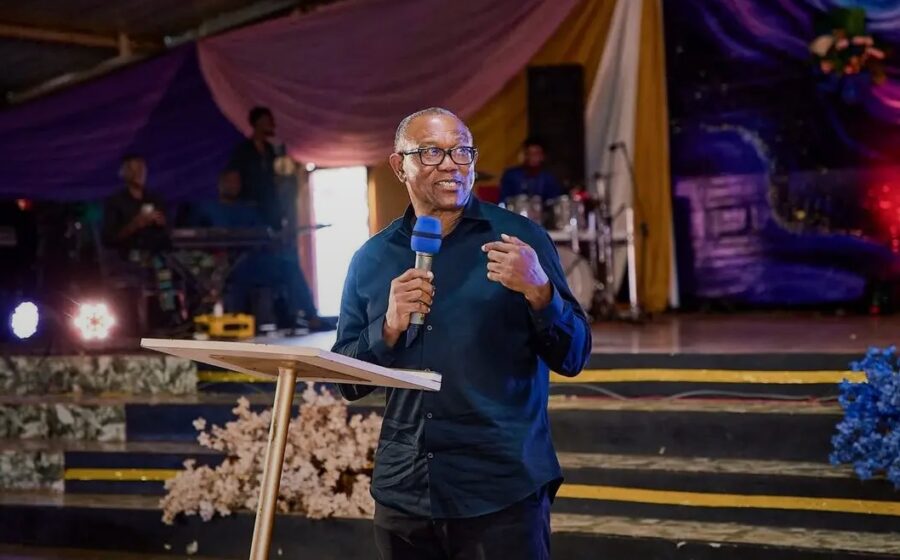
NDC presidential candidate Peter Obi says Nigeria must turn its history of national tragedies into a blueprint for unity and development, arguing that past failures of leadership should guide future policy rather than divide the country.
In a statement released on Friday, Obi said he received “many calls and text messages from patriotic Nigerians” who were upset after an Arise News anchor asked him questions about the 1966 coups. He said he was prepared to address any question about Nigeria’s history.
“As a presidential candidate, I am ready and able to answer any questions about anything relating to Nigeria. I have a commitment to serve the people, not to hide from them,” Obi stated.
He linked past events including the 1966 coups, the civil war, and various episodes of mass violence across the country to what he called a “failure of leadership to guarantee all its citizens equal rights and freedoms, and to enforce the fundamental rights in the constitution without fear or favour.”
Learning from other nations
Obi said mistakes in history “are not fatal” and can become “opportunities for transformation.” He cited examples from Asia and Africa to support the point.
He referenced Japan’s economic rise between 1920 and 1970, saying it was driven by “patriotic leaders who used the Japanese trauma of colonial rule to drive miraculous economic development.”
He also pointed to South Korea, which he said “weaponised cruel experiences under Japan to develop a policy framework of a developmental state” under General Park from 1960, and to China under Deng Xiaoping, who “reinvented China from the tragedies of Chairman Mao’s Cultural Revolution.”
“Today, China is the second-largest economy in the world. What a transformation. That is our vision. That should also be our history,” Obi said.
Closer to home, he said Nigeria “can learn from Rwanda on how a recent terrible experience is being used to advance national unity and prosperity.”
Call for forward-looking leadership
The NDC candidate said his responsibility as president would be “to turn the pains and tragedies of the past into opportunities to make Nigeria united, stable, and prosperous.”
He called for “a leadership that is not trapped in the past, a leadership that focuses on what binds us together rather than what divides us.” According to Obi, Nigeria needs a leader who “publicly proclaims that all parts of Nigeria abound in human and natural resources, and that all parts of Nigeria can become productive and prosperous.”
“The difference in human history is having leaders who do not maximise those pasts for selfish ambition but leverage them to build a prosperous future for all,” he added.
Obi concluded by saying he is ready “to speak about what the voters consider important” and “to lead from the front as we work to turn away from the ugly past and into a future where no Nigerian will suffer on account of his or her ethnicity, religion, or social pedigree.”
“Our past is important, but our past is not our destiny. Our future is what we do with our past. Our past is our resource for national transformation. We are ready to transform Nigeria,” he said.