

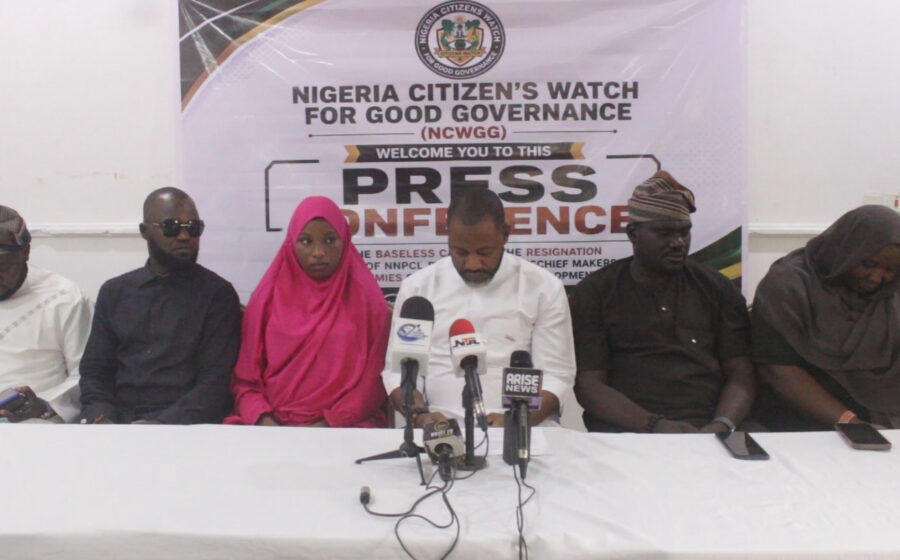
The Nigeria Citizens’ Watch for Good Governance (NCWGG) has dismissed calls for the resignation of the Group Chief Executive Officer of the Nigerian National Petroleum Company Limited, Engr. Bashir Bayo Ojulari, describing the demand as “baseless, economically illiterate and fundamentally unfair.”
Addressing journalists in Abuja on Monday, NCWGG National Chairman, Collins Idowu Eshiofeh, said the call followed a publication that questioned about N7.13 trillion listed in NNPC Ltd’s 2024 financial records as “energy security and pipeline protection expenses.”
Eshiofeh said the N7.13 trillion was not a single, opaque contract but funding for a multi-year national security programme covering aerial and maritime surveillance, leak detection and fibre-optic sensing, community intelligence, logistics for security forces, and rehabilitation of thousands of kilometres of pipelines.
He linked the expenditure directly to improved oil output. According to him, daily crude production fell to as low as 900,000 barrels per day in 2022 before the current security architecture was deployed. It has since risen to an average of 1.5 million barrels per day in 2024, and has consistently exceeded 1.6 million barrels per day in recent months including condensates.
“That is an addition of roughly 600,000 barrels per day. At an average oil price of eighty dollars per barrel, the additional 600,000 barrels per day translates to approximately 48 million dollars in additional daily revenue for the Federation, or over 17 billion dollars a year,” Eshiofeh stated.
He added that the operations have led to the deactivation of more than 6,000 illegal refineries, the recovery of hundreds of millions of litres of stolen crude and refined products, and the dismantling of thousands of illegal pipeline connections. He said these outcomes are documented in NNPC Ltd’s monthly reports published on its website and in briefings to the National Assembly.
The group also rejected allegations that Ojulari’s leadership is synonymous with “secrecy, weak accountability and growing public distrust.”
Eshiofeh cited NNPC Ltd’s 2024 Audited Financial Statements, released in 2025, which showed a profit after tax of N3.297 trillion. He said the 2024 financial records also indicated profit after tax exceeding N2.5 trillion despite global market pressures. Both documents, he said, are on the company’s website and audited by firms of international standing.
He further noted that NNPC now publishes monthly financial and operational reports and runs a transparency portal for procurement records and contract awards. All security contracts, he added, follow the Public Procurement Act and NNPC Procurement Manual.
On claims of a “backdoor subsidy,” Eshiofeh said the security spending has no connection to petrol pump prices. “A subsidy is a price differential that government pays to keep pump prices artificially low. The N7.13 trillion in security spending has nothing to do with the price of petrol at the pump,” he said, adding that the fuel subsidy was removed in May 2023 and that Ojulari has implemented that policy.
Eshiofeh described Ojulari as a leader of “unimpeachable integrity” with over three decades in the industry. Prior to NNPC, Ojulari served as Managing Director of Shell Nigeria Exploration and Production Company and as Chief Operating Officer of Renaissance Africa.
The NCWGG chairman called on President Bola Ahmed Tinubu to disregard the resignation demand, saying it came from “aggrieved rent-seekers who profited from the decades of opacity.” He urged continued presidential support for the NNPC Board led by Engr. Ahmadu Musa Kida and the management team headed by Ojulari.
He also asked the National Assembly to conclude its joint investigative panel on the expenditures quickly, expressing confidence that the report will confirm the spending was “properly incurred, competitively awarded, and yielding measurable value.”
The press conference comes amid public debate over NNPC Ltd’s security budget and transparency following the company’s transition to a commercial entity under the Petroleum Industry Act 2021.
NCWGG concluded that Nigerians are witnessing “the first sustained chapter of openness” at NNPC, with declared profits, audited accounts, disclosed contracts, and rising production.