

Senior Special Assistant to the Vice President, Kashim Shettima on Media and Communications, Stanley Nkwocha, has questioned whether NDC presidential candidate, Mr Peter Obi, is negotiating a single-term presidency for the collective aspiration of Ndigbo or for his personal ambition.
In a statement issued in Abuja on Tuesday, Nkwocha said the question became necessary following reports of a possible political understanding between Obi and Senator Rabiu Musa Kwankwaso ahead of the 2027 general elections.
“Did he negotiate four years for Ndigbo, or did he negotiate it for himself?_” Nkwocha asked, adding that if true, such an arrangement “goes beyond personal ambition” and touches on the broader issue of political representation and the South-East’s long quest for the presidency.
Nkwocha, who serves in the Office of the Vice President, said the reported four-year pact is troubling given the decades of exclusion Ndigbo have experienced at the presidential level since 1979. He cited attempts by Dr. Nnamdi Azikiwe, Dr. Alex Ekwueme, and Owelle Rochas Okorocha as examples of past efforts that did not succeed.
“That history is not a small matter. It represents decades of aspiration, negotiation, disappointment, and political recalibration. The desire for an Igbo presidency is therefore bigger than Peter Obi. It is bigger than any one politician, party, campaign slogan, or social media movement,_” he stated.
He argued that the reported willingness to accept a one-term arrangement raises questions about consultation and strategy.
“If Ndigbo have waited this long for the presidency, should their most visible aspirant be negotiating a four-year tenancy in Aso Rock as though the matter is a personal career bargain? Did he consult widely with Igbo political, traditional, business, and intellectual stakeholders before entering such conversations?_” Nkwocha said.
The presidential aide also linked the reported pact to the current political cycle, noting that after eight years of President Muhammadu Buhari, power returned to the South in 2023 through President Bola Ahmed Tinubu. He said the general understanding in many quarters is that the South should complete eight years before power shifts back to the North.
“Should the South-East stake its historic presidential aspiration on a hurried four-year term or should Ndigbo pursue a broader, more patient, and more sustainable national negotiation that can produce a presidency with stronger legitimacy and a fuller mandate?_” he asked.
Nkwocha further assessed Obi’s political reach, saying while the 2023 election showed his ability to mobilize young and urban voters, it also exposed limitations in penetrating the North and South-West. He contrasted this with President Tinubu’s decades-long investment in alliances across northern political, religious, business and traditional networks.
“Obi’s 2023 performance showed that he could energise a movement. But it also showed the limits of a campaign that could not sufficiently penetrate the North, did not command the South-West, and relied heavily on emotional momentum rather than durable political machinery,_” he said.
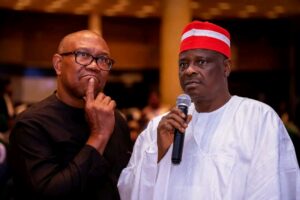
On the reported alliance with Kwankwaso, Nkwocha said the former Kano governor has a strong base but may not have the nationwide northern reach needed to deliver the presidency. He added that if the price of that support is a four-year concession, then it may be “a poor bargain dressed up as strategy.”
He referenced Obi’s recent interview with Channels TV’s Seun Okinbaloye, saying it raised more questions than answers and exposed gaps in his record and positions.
“The interview was uncomfortable to watch. Rather than clarify his record and strengthen public confidence in his capacity, Obi appeared defensive, evasive, and increasingly trapped by the burden of his own political claims,” Nkwocha stated.
Despite his criticism, the presidential aide said an Igbo presidency remains “possible, legitimate, and desirable” within the framework of national inclusion, but warned that it cannot be achieved through “emotional blackmail, hurried bargains, or political shortcuts.”
He suggested an alternative path for Obi, urging him to prioritize collective interest over personal ambition.
“ He can support President Tinubu’s completion of the South’s turn in 2027, work with other Igbo leaders to deepen negotiations across the country, and help prepare the ground for a stronger Igbo presidential bid in the future. Politics at its noblest level is not always about who contests now. Sometimes it is about who helps create the conditions for a more sustainable victory later,_” he said.
He can support President Tinubu’s completion of the South’s turn in 2027, work with other Igbo leaders to deepen negotiations across the country, and help prepare the ground for a stronger Igbo presidential bid in the future. Politics at its noblest level is not always about who contests now. Sometimes it is about who helps create the conditions for a more sustainable victory later,_” he said.Nkwocha concluded that the South-East deserves more than what he called “a symbolic four-year bargain” and deserves a serious national negotiation built on trust, structure and strategic maturity.
“In the end, Obi must answer the question his reported pact has placed before the country: did he negotiate four years for Ndigbo, or did he negotiate four years for Peter Obi?_” he said.
Report By: NEWS CENTURY TV