
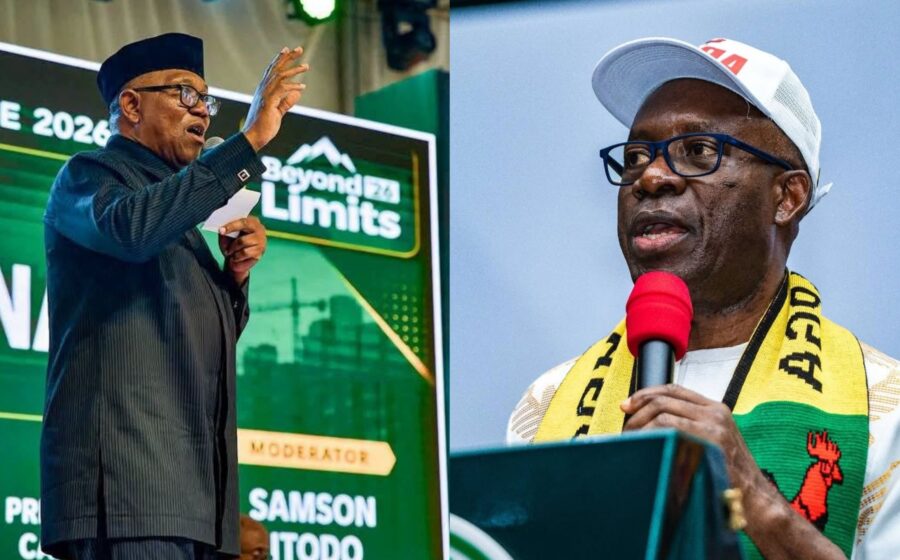
The presidential candidate of the National Democratic Congress, NDC, Mr. Peter Obi, has dismissed claims that he left a $123.77 million debt burden for Anambra State, describing the figures being circulated by the Anambra State Government as an incorrect application of public-sector accounting.
In a statement titled “ON THE ANAMBRA DEBT QUESTION” released on Friday, Obi said he had remained silent over the past few days because he was grieving the loss of his elder brother and friend, Chief Okey Ezeibe.
Obi urged Nigerians to concentrate on the existential challenges confronting the country rather than what he called needless political distractions.
“I wish to assure the public that I have no disagreement with my dear elder brother, Governor Soludo, or with any governor in Nigeria. I am not seeking the office of governor in any state, and I will not seek that position again, even if the Constitution is amended,” he said.
He appealed to governors to support whichever presidential candidate they choose while allowing other candidates to campaign freely in their states.
Addressing the core issue, Obi stated unequivocally that as Governor of Anambra State, he did not approach any financial institution to borrow funds or issue a bond on behalf of the state.
He recalled that at his farewell ceremony, the then Director-General of the Debt Management Office, DMO, Abraham Nwankwo, declared that during his 10 years in office, Obi was the only state governor who had not approached him for a loan facility.
“When I left office, the Anambra State Government owed no unpaid salaries, gratuities, or pensions. Neither did it owe any contractor or supplier who had completed work that the government had verified and certified,” Obi said.
On the multilateral funding being described as debt, Obi explained that they were concessionary development-support funds secured by the Federal Government for states selected by it to address specific needs, with repayment spread over 25 to 30 years.
He said the Anambra State Government must differentiate among three separate figures: the total amount approved for the multi year development program; the amount Anambra State actually drew during his tenure; and the funding balance outstanding when he handed over on 17 March 2014.
“The government has combined these distinct categories, added them together, and described the resulting US$123.77 million as ‘loans left by Peter Obi.’ That is an incorrect application of public-sector accounting,” he said.
Obi noted that the eight facilities identified were primarily World Bank and IFAD development programs negotiated by the Federal Government, not conventional commercial loans he personally secured.
He pointed to what he called a clear contradiction in the government’s own figures. According to him, while the government claimed the original facilities amounted to $123.77m and that $92.35m remained outstanding in June 2026, DMO records showed Anambra’s total external debt at approximately $18 million when he began his tenure in March 2006, about $30 million in March 2014 when he left, and approximately $45.15 million as of 31 December 2014, nine months after his departure.
“The Anambra State Government must therefore clarify how a state whose recorded external debt was about US$30 million in March 2014 and US$45.15 million in December 2014 could supposedly have inherited US$123.77 million from Peter Obi, who left office in March of that same year,” he queried.
Obi also disclosed that on the day he left office, he left more than $150 million as the dollar component of his investment for Anambra State, which he said was expected to provide the state with approximately $10 million in annual income.
“Even if their assertion were accurate — which it is not — that Anambra owed US$123 million, the government could have used the US$10 million generated annually from my savings to reduce the debt. It has now been 13 years since I left office, which would amount to US$130 million. The debt should have been fully settled by now,” he argued.
He added that had the funds been retained with compound interest, the total would be approximately $335 million today, and after repaying the alleged $92.35 million, about $242 million would remain to generate $20 million annually for the state.
Obi reiterated that when he left office, Anambra was in the strongest financial position of any state in Nigeria, adding that he would no longer engage in words with anyone regarding his tenure, as his focus remains on issues affecting suffering Nigerians.
“A new Nigeria is POssible,” he concluded.